Your contribution to Against Everyone With Conner Habib is vital. Support the show with a monthly or or annual pledge via patreon.com/connerhabib. Or make a one-time contribution via Square.
LISTEN ABOVE VIA SOUNDCLOUD or
SPOTIFY • APPLE PODCASTS • POCKET CASTS • CASTBOX • PLAYERFM
Friends,
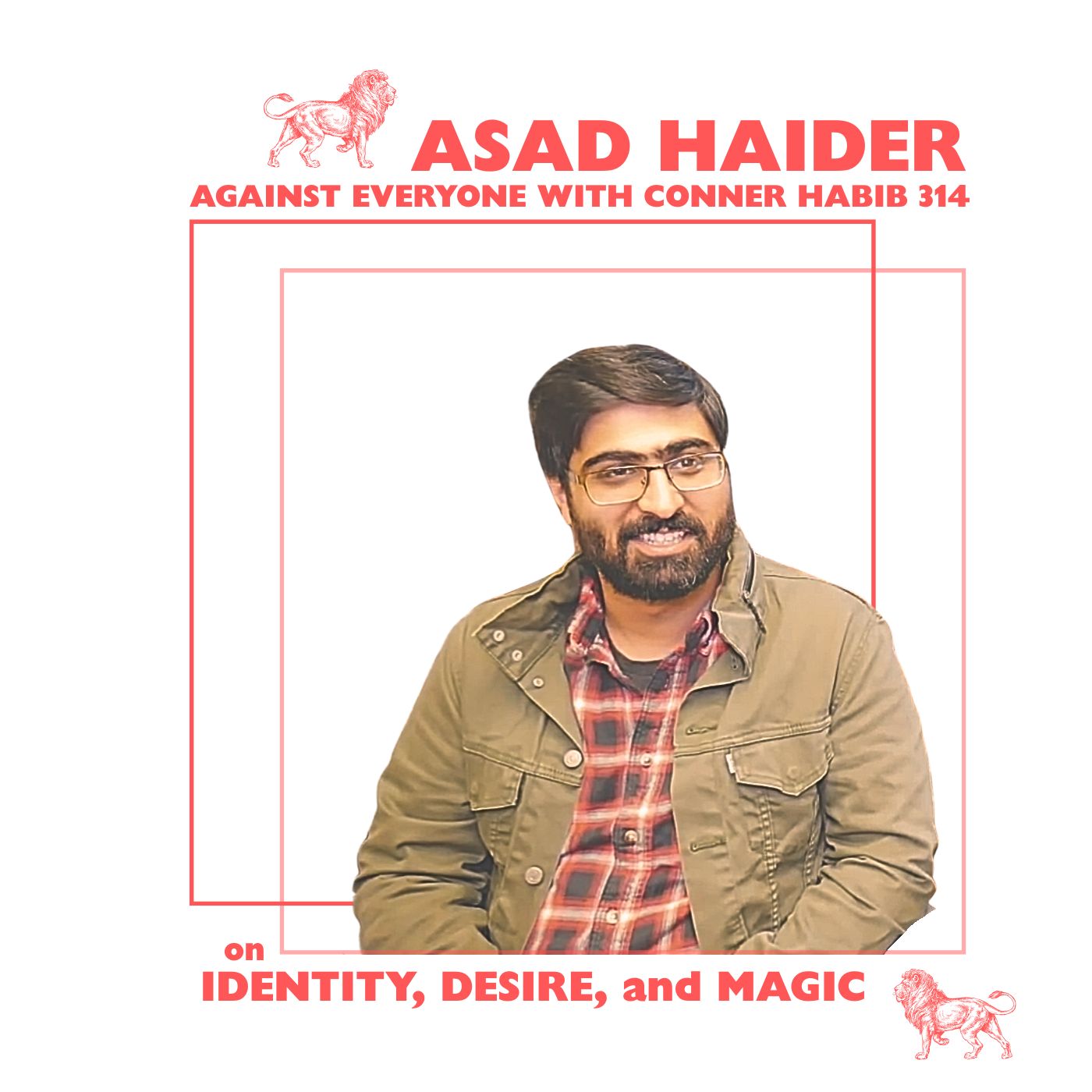
Asad Haider, the political theorist and philosopher, whose book critiquing identity politics from a (non-class-reductive) leftist perspective, Mistaken Identity: Mass Movements and Racial Ideology remains a powerful contribution and who was on AEWCH 26, died suddenly in December of last year. I’ve reproduced that episode as AEWCH 314*, with a new introduction.
Asad was someone I had always planned on being friends with but for whom I’d never made enough effort to really make it happen. He was brilliant, funny, warm, and so open to talking in whatever direction the conversation wanted to go.
Asad and I connected in 2018 over our similar childhoods growing up in Pennsylvania, and we did it in a time when it felt like all sorts of new or newly articulated ideas – about race, class, culture, and politics – were starting to break through into mainstream consciousness. I had worried, in fact that speaking in that time meant some touch points on our episode – the first Trump administration, and Rachel Dolezol, etc. – would feel outdated. But in fact, the episode comes across as more relevant than ever.
I only wish I’d talked with Asad again. I know he would have lots to offer on the recapitulation to and exacerbation of themes from 2018 in our time.
While I want to focus on Asad, along with him, three other people I know have died since late November.
My friend James “PJ” Ransone, who you might have heard of: an actor in The Wire, Sinister, Tangerine, It, and The Black Phone. PJ helped me stabilize after a difficult breakup, and also loved telling me his elaborate and involved theories about the world.
So it’s been impossible for me to not think of death: the way people we don’t know, not really, die, and the way we long for them, and don’t even understand the longing.
And then I think again of Asad. He was so interested in identity and the way we draw on a commonwealth much deeper than our identities.
This commonwealth of the dead, the love and connectedness we all have to each other which is revealed by all these different deaths, is so very deep. A true community, always near us, always instructing us.
I hope you appreciate the conversation with Asad and may you be comforted in your own lives and different deaths.
*(I’ve edited it from the original to give Asad a little more of the airtime and me a little less.)
SHOW NOTES
MORE ON ASAD AND HOW TO PLANT A TREE IN HIS NAME
Here’s Asad’s obituary, and if you appreciate the things he’s said or his work more broadly, you can – for not much money – plant a tree in his name.
Here’s a link to all of Asad’s essays in the magazine he cofounded, Viewpoint.
MORE ON THE EPISODE
Asad’s brother, Shuja Haider, is also a writer He especially writes about music. Here’s his site.
Amrish Puri is the heart-puller-outer in Indiana Jones and the Temple of Doom, and I was pretty terrified of him as a kid. Also repulsed by the way the skin over the heart just sort of oozes back together like oatmeal. I’ve found a full copy of the movie Asad mentions, Ajooba, on YouTube. I haven’t yet watched it, but I gotta say, the movie poster is pretty promising.
Some of the Michel Foucault S&M-meets-identity stuff Asad mentioned can be found in Ethics: Subjectivity and Truth (Essential Works of Foucault, 1954-1984, Vol. 1) , particularly in “Sex, Power, and the Politics of Identity”. If I find an online copy of that somewhere, I’ll repost here (but feel free to add it in the comments if you can find one).
Lacan’s quote is ““What you aspire to as revolutionaries is a new master. You will get one.” And here’s the great video of the situationist student confronting Lacan.
If you haven’t seen Jodorowsky’s Dune, you really, really must.
Adam Phillips states. wonderfully, and often, that psychoanalysis is like poetry. Here’s a sample of his writing on the topic.
 Conner Habib
Leave a comment