There’s been plenty going on here lately. So while the next blog entry is in progress, here’s some info on upcoming Conner Habib events, as well as excerpts from a recent essay.
EVENTS
I was recently asked to NOT speak at Corning Community College – a decision made by the president, against student wishes. There will be an essay up about this is soon (probably today). But I rescheduled the talk at the Southeast Stueben County Public Library in Corning. If you’re in the Buffalo/Syracuse/Rochester area, please come. The talk is free – I’ll be addressing the whole fiasco and having an open discussion with the audience about pornography and culture. For details, see the flier to the left.
Just did a webinar with legendary futurist and mystical thinker, Daniel Pinchbeck, as well as ex-CIA employee and psychic researcher Russell Targ. One of the craziest most exciting things I’ve done.
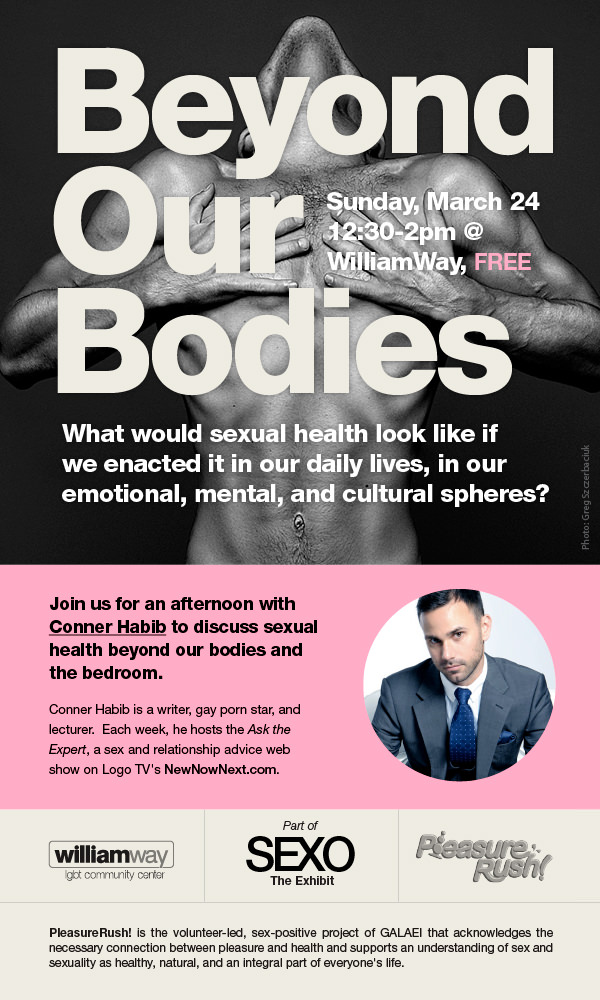 On Sunday, March 24, I’ll be speaking at The William Way LGBT Center in Philadelphia from 12:30 – 2:00, about sexual health beyond the bedroom. Check out the flier to the left or learn more about the Center by going to their website.
In April, I’ll be speaking at The Center for Sex and Culture in San Francisco with Chris Donaghue, the host of Logo TV’s Bad Sex. The talk is called “Sex and Your Cellphone: The Death and Rebirth of Technology, Sex, and Relationships.” We’ll each be talking for a bit, then interacting with each other and the audience. I’ll also be speaking at USC in Los Angeles! I’ll post more on those events here in the future, but keep an eye out!
***
ESSAY
Recently, I read pop philosopher Alain de Botton’s book on sex, How To Think More about Sex. It wasn’t just a hugely disappointing book from a writer that I’d previously felt some affinity with, it was dangerous and reactionary. I was surprised at his anti-sex rhetoric, and his flourishes of fundamentalist thought. So I wrote a review article for Full Stop magazine, an excellent online literary journal. You can read the full review here, and below are some excerpts.
“There are a lot of ways to go to war against sex and to champion repression. Because sexual freedoms depend on clear thinking about sex, these attacks always have a strong ideological component. Religious leaders have used The Almighty to shame the body. Psychologists have reduced vast regions in the landscape of desire to mere pathology. Evolutionary biologists and anthropologists have claimed that there is nothing essentially human about sex; that the natural male instinct is toward animalistic violence and rape, the natural female instinct is to be dominated. Certain feminists have claimed that the act of heterosexual sex is itself an act of aggression against women.
One common feature of these attacks on sexuality, sexual liberation, and clear thinking about sex, is that they present at least one component of their arguments as self-evident. A simple example of this can be found in attacks on pornography, which often angrily and urgently detail the sexual acts in the scene — threesomes, foursomes, the use of fetish objects, rough sex, etc. — but offer little explanation as to why we should be outraged by portrayal of these acts, hoping instead that whoever’s listening will have an automatic sympathy with the critic’s unthinking revulsion.”
“or de Botton, sex is not a giving capacity; it isn’t valuable in and of itself, and it doesn’t add to life through its own merits. Instead, sex is a means to an end. One end is procreation. The other — more thoroughly examined in the book — is the temporary relief from loneliness. The result is — and Alain de Botton doesn’t seem to have noticed this — that How To Think More about Sex is a book that is far more about loneliness and alienation than about sex itself. Because alienation is the book’s main concern, and because de Botton tells us that we all feel alienated by sex, the book is permeated by and never quite shakes the feeling of Original Sin; in other words, he assumes we all start from a fallen place, since we are born into loneliness.”
“To introduce us, in the book’s worst chapter, to the “poison” of pornography, Alain de Botton brings us his thoughts via his favorite Greek, Aristotle. He writes,
‘Nobility, as Arisototle conceived of it in the Nichomachean Ethics – ‘the full flourishing of what is most distinctively
human in accordance with the virtues’ – has surely been left far behind when an anonymous woman so
mewhere in the former Soviet Union is forced onto a bed, three penises are roughly inserted into her orifices and the ensuing scene is recorded for the entertainment of an international audience of maniacs.’
One wonders if Alain de Botton has read anything about Greek culture. He might have at least tried to indicate Greek sexual attitudes and their graduation into all-pervasive sexual imagery in ancient Rome. He avoids the historical context of sexual imagery all together. For him, pornography is severed from history and starts with the Internet.”


 Conner Habib
Leave a comment