
Friends,
It is again Michaelmas, the celebration of the archangel Michael, when we cultivate a courage within ourselves and agree to stand firm.
Of course this giving-over of the inner processes of creating strength is needed now more than ever. The world’s karma has involved us in its element-trials: of committing to endure the fire of a new and definite spiritual view; and committing to being stable and moving-with the throwing about of the waters of world events. As these forces confront us, the temptation to collapse or hide in a familiar shelter is almost overwhelming. But neither of those gestures will save us. If we collapse, we will be burned up. If we hide, our shelter will be flooded.
What does this mean?
Nothing less than total faithfulness to a beautiful world that has not arrived, not even in our imaginations.
Nothing less than the agreement to eradicate views of that future that come pre-formed by experiences and tensions of the past.
The Archangel Michael (and to some extent, a new mystery, which I will speak about more on future episodes) assist us here.
I’ve talked about the Archangel Michael at length on AEWCH 275 (which includes my original episode on the subject, AEWCH 126). Those episodes are not merely intellectual musings on the topic, but examples of the way the Michaelic impulse shows up in our lives.
Here, I’d like to Investigate a face of Michael that I didn’t look at on those episodes.
Drawing here first largely from the middle east, from what we now call Iraq, Iran, and parts of Syria and Turkey, we find the Mesopotamian stories of Tiamat and Marduk. There are plenty of places to draw from to understand these myths, but aside from primary sources, I’ll draw from Rudolf Steiner and from AEWCH 302 guest, Federico Campagna and his excellent book, Otherworlds: Mediterranean Lessons on Escaping History.
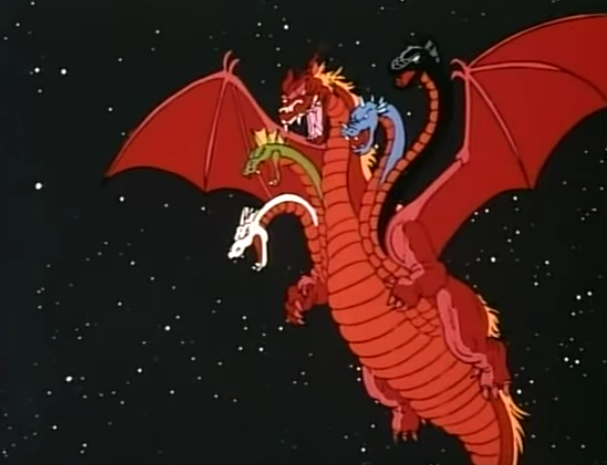
Tiamat was the being of dreams and of nightmares, a being made of the combined form of many beings. Pictured here from the (incredible) 1980s cartoon, Dungeons & Dragons, she is seen as a five-headed dragon, a terror to good and evil alike, capable of breathing all the elements out as destructive force.
In esoteric terms, Tiamat is the embodiment of the astral realm before it became available to us. Not only a therianthrope (a human with an animal’s head) or a chimera (an impossible blend of differing animals), but all the animals, all the imagined beings, all the not-yet-realized images. She contained everything in her mother-body.
Her children – gods themselves, created from her body and sent to work in the cosmos – wanted to use the power available to her alone. To create new forms and order the world from the sprawling mass of imaginal chaos that she embodied. Displeased with their desires, Tiamat generated an army from herself of demons and animal-beings, and worse, she summoned a being to lead them, the terrible Kingu, to silence her children.
She set up the viper, the dragon, and the lahamu,
The great lion, the mad dog, and the scorpion-man,
Driving storm demons, the dragonfly, and the bison,
Bearing unsparing weapons, unafraid of battle.
Powerful were her decrees, irresistible were they.
Led by Kingu, the forces of chaos descended onto the agents
of order. And the young gods trembled with fear.
We see an echo of this congregation of monsters in Italian communist Antonio Gramsci’s words, much closer to our time: “The old world is dying, and the new world struggles to be born; now is the time of monsters.” And yet, the fate of the monsters is, as well shall see, surprising.
Tiamat’s fight was quick and furious against her children. Like many elder gods in many pantheons, she subdued her children. And those who would not submit? She killed them. Ate them. Reabsorbed them.
Who could stand against her?
Only the unsuspected. Only the underestimated. The unnoticed.
Only the one who could generate his own strength without resorting to taking strength from Tiamat.
His name was Marduk.

Pictured here from the 1980s cartoon, The Real Ghostbusters, Marduk is seen as he is described in the Enuma elish, a myth cycle rediscovered in the 19th century, but composed sometime between 2000 – 1001 BCE.
Four were his eyes, four his ears,
Flame shot forth as he moved his lips.
His four ears grew large,
And his eyes likewise took in everything.
Because Marduk was not seen as a proper warrior at first, the other gods demanded he prove himself. “Before accepting the newcomer as their leader… the younger gods demanded proof of his divinity. They summoned Marduk to the Court of the Assembly and place a garment in front of him. ‘By word of thy mouth,’ they told him, ‘command that the garment be destroyed. Then command again, and let the garment be whole!’ Marduk obliged. He spoke and the power of his word destroyed the garment, Then, through his word, he made it whole again.” (p. 25 of Otherworlds)
In other words, to prove himself, Marduk had to show that his power, his word, was not only destructive, but creative. The same word was able to both rend and mend.
In fact, Marduk promises that his word, his commitment to battle is really a commitment to freedom and creation. Not just against Tiamat, but to even against the other gods who need him in the battle, he says:
“May I through the utterance of my mouth determine the destinies instead of you.”
Marduk confronts Tiamat and Kingu, as well as their army of monsters and animals. He defeats the army, and then kills them both. Notably, he kills Tiamat not with a sword, but an arrow that splits her in two. Because of what comes next, we might wonder if this arrow, shot from its bow, was not an arrow at all.. To find the arrow’s target, Marduk first blew the winds into Tiamat’s mouth. Then, finding a target, he shot into her lungs his arrow. Could it be that he opened Tiamat up to the presence of his word? (“You are the bows from which your children as living arrows are sent forth.” – Kahlil Gibran)
And then a remarkable act: with Tiamat’s corpse – using the wisdom-powers of his father, Ea – Marduk creates.
And what does create out of the being of dreams?
The world and the sky.
He split her open like a mussel and divided it into two
half of her he set in place and formed the sky as a roof.
The world itself is composed of densified dream, the corpse of the mother of monsters and gods: Tiamat. But Tiamat infused with the word of Marduk (and his father). And when we look up at the sky, we see gods, stories, constellations, and the night, again infused with the heroic deed of freedom-making.
But Marduk went further than this. When the gods that demanded Marduk prove himself saw that he had defeated Tiamat and her army, they made a new demand: That they have the monsters and spirit-animals in Tiamat’s army as slaves.
Rather than go along with this, Marduk refuses.
Again, with the wisdom from his father Ea, he creates by destroying.
He uses the blood of Kingu to ignite life in a new form: the human beings. Human beings become the actors of the gods, the ones who can carry out and do what the gods cannot. Now, the gods cannot act fully without us.
In slaying Tiamat and Kingu, Marduk distributed the life of effort into the human being.
Rather than being slaves (as some scholars suggest), we have the ability to act in relation to the gods out of an ancient alliance with them. Human will is connected to an ancient act of destruction and creation. Within all human beings is the spark of sacrifice and the history of effort and courage.
How do we honor this creation story and how does it relate to us today, especially around Michaelmas?
Let’s turn to the words of Rudolf Steiner on how to think about the self and the world all at once:
“From the East there echoes across thousands of years the saying: the world that we perceive with our senses is Maya, the Great Illusion. And if, as man has always felt during the course of his development, the world is Maya, then he must transcend the ‘Great Illusion’ to find ultimate truth…
‘Know thyself!’ —such is another ancient saying that comes down to us from the past. From the fusion of these two sayings—‘the world is Maya,’ from the East, and ‘know thyself!’, from ancient Greece—there first arose the quest for spiritual knowledge amongst later humanity. But in the ancient Mysteries, too, the quest for truth and reality had its origin in this twofold perception that, in the final analysis, the world is illusion and that man must attain to self-knowledge.
It is, however, only through life itself that man can come to terms with this question, not through thinking alone, but through the will, and through full participation in the reality immediately accessible to us as human beings.”
To know thyself is to develop spiritually. To understand our spiritual being rather than confusing ourselves, our lives, for the illusion, for the Maya. On the other hand, we must know ourselves and live in and along with the illusory world of Maya. We must participate in it. But spiritually.
Heres’ Steiner again, in a different lecture, one of the only ones in which he mentions Marduk:
“Michael is the same being as Marduk, the son of Ea, wisdom. The adversary consisted of demons born out of the night (Tiamat)… Out of this fight Marduk-Micha-el created the Heavens above and the Earth beneath, thus arose the Above and the Below.”
In other words, the principle of “as above, so below” relates to the ancient event of Marduk’s creative slaying of Tiamat.
Rather than think of “above” as the sky (which is made of the same stuff as the world, after all), the “above” is our own inner lives. The “place” where we develop our courage and ability to inwardly “be firm.” This inner steadfastness and firmness is stronger and in a way more “solid” and “real” than the world itself.
After all, the world is made of a giant dream-being.
This Michaelmas, be in touch with this truth:
As above, so below.
Both principles live with us.
The world of dreams, of maya, which we are made of and which we live in.
And the courageous deeds, the alliance with the gods, the principle of freedom, which lives in us.
When we live with the strength of that deed, when we promise to create with our strength rather than merely be destructive, when we defy the order of slavery and instead live through freedom in alliance with spirit, we encounter our time rightly.
We live in harmony with and strengthen the time-spirit: MICHAEL.
With love,
CH
CH
 Conner Habib
Leave a comment