
This is a short essay that appears in my newsletter; like the podcast, it’s free.
To subscribe, click here. This is important especially for casual readers of this site who might want posts that are exclusive to patreon patrons and newsletter subscribers. I would, of course, love for you to be a paid member of my patreon too! In a few weeks, posts like these will be featured exclusively in my newsletter and for paid patrons. Thanks!
***
“As an artist I am against every state, the state is concentric, man is eccentric.”
– James Joyce
At the beginning of summer, this whole green island where I live becomes consumed with talk of drunks and witches, philosophy and love, epic poetry and smut.
The day is called Bloomsday after Leopold Bloom, one of the three central characters of James Joyce’s 700+ page masterpiece, Ulysses, which takes place mostly on one day, June 16th.
In Dublin, people reenact scenes from the novels in the street, and dress up as Joyce’s characters. They eat the meals that Bloom ate (most famously, pork kidney, but there’s also toast and tea in the book for the less offal-inclined). They gather in pubs and read passages, they sit for lectures and take walking tours.
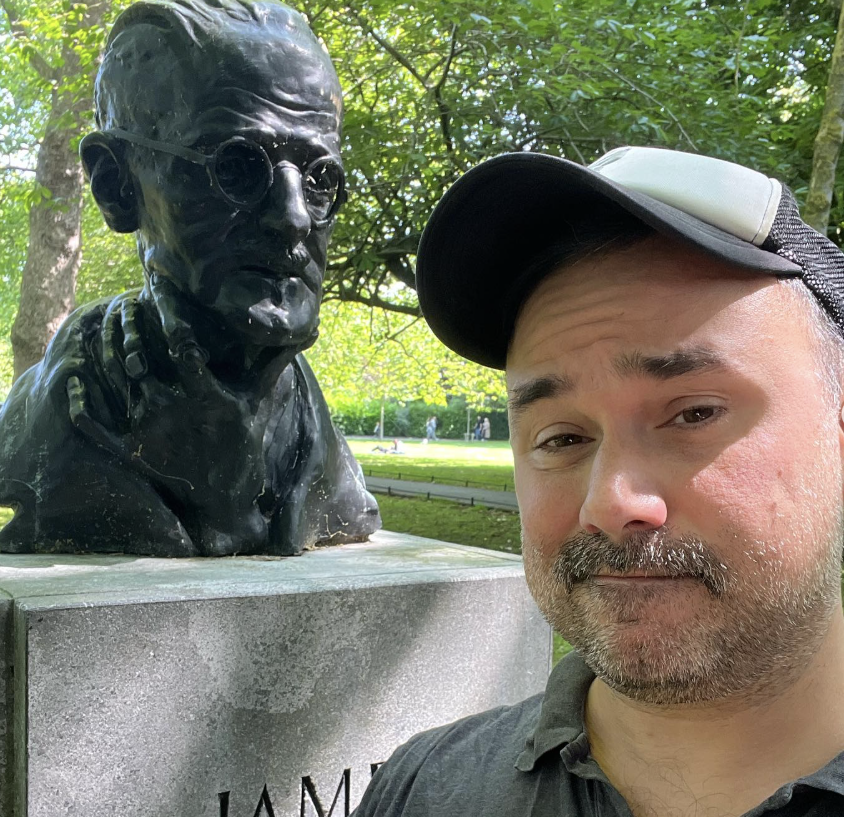
For the rest of the year, Joyce is never far either; Ireland is populated by his image.
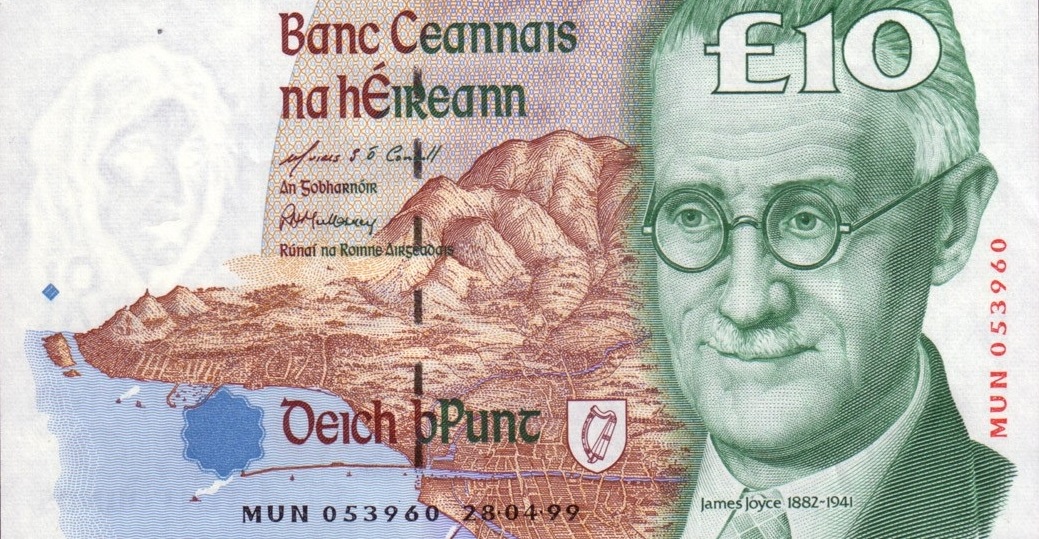
He strikes sculpted poses in busts and statues, he appears in murals on our buildings, and even inhabited the pre-Euro Irish 10 pound note. (Joyce, also a singer, was a tenor. “A tenor on a tenner,” the joke goes.)
Imagine, if you are in America, the countenance of a great author greeting you in the parks, smiling from your doorways, blessing your transactions. A novelist as visible — more visible — than the politicians who decorate money and insist themselves onto monuments. It’s almost unthinkable.
But somehow Joyce made it available to Ireland. Other authors are celebrated here too, but he remains the Sun whose light cultivates their flourishings.
That’s because his gift was the gift of intense commitment to the true work.
It’s what that makes him as available to us as he is, 85 years after his death at 58 years old (a palindrome of year and age he would’ve been sure to notice).
“Shut your eyes and see.”
– from Ulysses
Joyce wrote Ulysses, across seven years.
He did so in a poverty that followed him since he was a child, in a debt-burdened family.
Moving from country to country to seek financial support for his lifelong partner Nora Barnacle (who he did not marry until 1931) and his two children, he found himself all but begging for loans and work.
Physically, he was in constant pain. Joyce suffered from and excruciating and blinding eye condition. Doctors were unable to figure out the root cause, so Joyce experienced not just the suffering from his condition but the multiple procedures and surgical interventions for it that did not benefit from modern anesthesia.
“Joyce had to endure a horrific series of operations and treatments for one or the other of his eyes, including the removal of parts of the iris, a reshaping of the pupil, the application of leeches directly on the eye to remove fluid–even the removal of all of Joyce’s teeth, on the theory that his recurring iritis was connected with the bacterial infection in his teeth, brought on by years of poverty and dental neglect.”
(From James Joyce: A New Biography by Gordon Bowker)
And of course, World War I began just as he started the book. Upon him pressed the destabilization of humanity itself.
After he finished the novel, Joyce faced censorship, court battles, and general scorn from many other artists and publishers. (His saving grace were the anarchists and feminists who went as far as smuggling the book in parts into other countries and reassembling them.)
Now the book is considered the finest novel ever produced in Ireland, and by many, including myself, the finest novel ever written. It’s spawned thousands (maybe up to 10,000) books about it, and Joyce Studies has become a scholarly discipline.
“Ulysses was designed to produce readers capable of reading Ulysses”
– Declan Kiberd
As for the book itself, it’s famed for being difficult, but, as with life, the book is most difficult for those who fail to be true to themselves.
If you don’t know anything about Ulysses, the plot is as follows: two men wander through Dublin, while one of the men’s wives goes about her own day; the two men’s paths overlap until finally they meet, finding a a deep affection and understanding for one another through their differences; while the woman sorts through her own affinities and antipathies.
That’s it.
What makes Ulysses so profound is its deep understanding of what a day in life is. That understanding is also the root of what people find difficult, because to express it, Joyce had to show us – through many maneuvers of literary style – who we were, and how vast an inner being each of us held.
“Each adventure (in Ulysses) is so to say one person, although it is composed of persons — as Aquinas relates of the angelic hosts.”
– James Joyce
People refer to those stylistic maneuvers in Ulysses “stream of consciousness.” They are anything but. In fact, they are as accurate picture of reality as literature has ever given us. It’s just that we don’t allow ourselves to go into realm of our own experience.
Ask yourself: as you go about your day, what your the experience of it?
You’ll find there is a continuity between thoughts and objects and words and actions and desires. Thoughts are arising concurrently with your morning walk. The rooms that hold you, the town around you, the air, the placement of your hands, your desires, the things that happened earlier in the day or what you are imagining may happen tomorrow all bounce in and out of each other.
But we don’t let that in, we keep to a small view of ourselves by allowing thoughts and desires and ideas flit by, while deciding that objects are “real.”
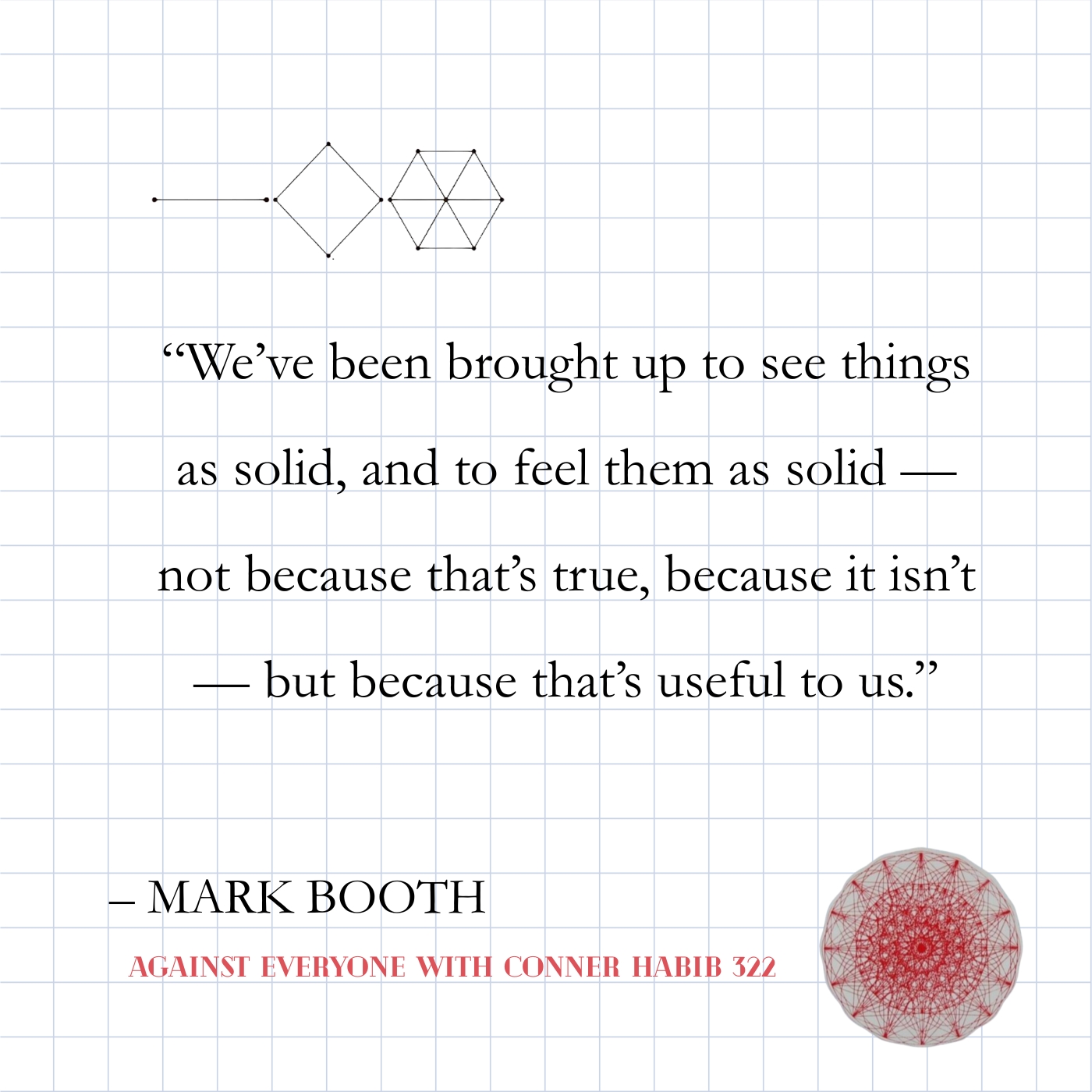
But thoughts are as real as objects. Your dreams are as real as your chair. To put it one way, here’s a guest from my show:
As for Joyce and Ulysses more directly, here are Robert Anton Wilson’s thoughts:
“Joyce has given us more realism than any other novelist and the upshot of it is that we don’t know what’s real anymore.”
Our real world contains much, much more than we attend to. When we read Ulysses, we see that. As we follow the characters of the book, it’s laid out bare: their inner world blends with the outer. There are no discrete boundaries between the reality of objects and the reality of our inner lives.
The “real” world is the part of our inner lives that dresses itself in separation, so it appears to be outside of us.
Joyce said as much himself:
“Most lives are made up like the modern painter’s themes, of jugs, and pots and plates, back-streets and blowsy living-rooms inhabited by blowsy women, and of a thousand daily sordid incidents which seep into our minds no matter how we strive to keep them out. These are the furniture of our life” (From Conversations with James Joyce by Arthur Power)
Since the world is as much a mindscape as a landscape, we live in something less humdrum, more wild and magical, than we believe.
Ulysses plays with this by echoing mythic structures, and then mocking them.
If you’ve never read Ulysses, the one thing you probably know about it (aside from the fact that it’s rumored to be difficult) is that is follows the structure of The Odyssey. Each “episode” of the novel echoes, in some way, an episode of Homer’s epic verses. This fact is a bit overemphasized – each chapter can also be said to trace Hamlet, a bodily organ, and more; and Joyce himself lamented its overemphasis.
But the deep truth in the structure is not that there is some dazzling literary trick. Instead, it is that Joyce shows us that each day of our lives is an epic. What the Greeks committed to in deeds, we have in the life of the mind. No moment of life, now, is without struggle, striving, elation, confrontation, vice, virtue.
A day wandering is a journey from one side of our psyche to the other. We wake as one person, and we sleep as another.
Knowing that this universe is within us, that each day is an Immram, we must constantly stabilize ourselves with the search for the true self.
Can we manage the voyage without being pulled into the whirpool, eaten by the monsters, turned into mindless pigs, or forgetting ourselves entirely?
Part of the genius of Ulysses is that it requires a commitment to yourself to read it at all. It’s the same closeness to yourself that gets you through. Reading the book is a practice of development of asserting the righteousness of your own being. That sounds grandiose, but you feel it as you read Ulysses. It’s why people have such a sense of accomplishment when they finish it.
The key is to discard the idea that there is a “right” interpretation of the book and instead approve of your own. Ulysses can be read many ways. In fact, it can be read in as many ways as there are readers. Joyce himself noted the temerity of those who say anyone had the “wrong” way of reading Ulysses.
That doesn’t mean the book is a free for all, of course; instead it means the book is open to you and your individuality as a reader.
The scholars will knock you about.
The world and its politics will knock you about.
The approved version of reality will knock you about.
In each case, you can lose yourself to minor or major forces.
And yet, there is a true compass to navigate by, and that is the inner self, the one that is driven to do the true work of your life no matter what is happening.
You notice in Joyce’s life; just as you notice this as you read Ulysses; just as you notice it when you stay close to your own true work, whatever that might be.
James Joyce – however drunken, vulgar, egotistical, clumsy he might have been at the surface of his personality – stayed close to his destiny.
In this, he remains a model for us.
In the terrors of war, pain, and poverty, a book, Ulysses – his destiny – remained the golden thread he held onto.
Joyce’s living presence in Ireland comes from a tremendous act of free thinking, free feeling, and free will. It was not political acumen that earned him a place, nor money, nor approval, and certainly not deference to cultural gatekeepers.
What was happening outside the window could not touch the power of what he knew to be true: writing the book. Doing the true work.
This profound insistence opened up into a world-changing presence and afterlife.
Happy Bloomsday, everyone.
May you read Ulysses. And beyond that, may you find the singular purpose, the true work, the Ulysses of your life, and create it, whatever it is.
May you see yourself and say yes.
Love,
CH


Leave a comment