Friends, this is a short essay that appears in my newsletter; like the podcast, it’s free. If you’d like to subscribe, click here. My previous newsletter featured a euology for my friend Gordon White ,who died a few days after the events in this post took place. While this essay is being posted here, soon these essays will soon appear only in my newsletter, or as posts on my patreon. Of course, I’d love if you signed up for my patreon, too.
***
When you were lying in your bed and couldn’t sleep
Thinking couldn’t we be doing this
Differently?
I’m listening to every little whisper in the distance singing hymns
And I can
I can feel things
Changing
But it’s so hard
We got our heads down and our hackles up
Our back’s against the wall
I can feel your heart racing
None of this was written in stone
The currents fast but the river moves slow
And I can feel things changing
Even when I’m weak and I’m breaking
I stand weeping at the train station
‘Cause I can see your faces
There is so much peace to be found in people’s faces
– Kae Tempest, from “People’s Faces”
Just a few minutes before I was assaulted on a street in Dublin, I was thinking about getting mugged.
I was remembering how, not so long ago, someone came up to my friend in Brooklyn, pulled out a gun, and said they wanted whatever it was he had.
After that, my friend moved out of his neighborhood.
What would I do if I were mugged? I thought. Would I do what Doug did and leave?Anyway, I always had my mind on somewhere with less people, more sheep, more hills, and more fairy trees. It’s not like I needed the excuse.
Oh but that’s right, I corrected myself. There aren’t really any guns in Ireland. I mean there are some, but not American-Levels-Of-Guns. People get mugged in Dublin, sure, but what happens more often is that people get their asses kicked for no reason.
Is that better or worse?, I wondered.
People in Dublin get knocked out, beaten up. More likely to survive, less likely to walk away unscathed. So instead of being mugged, what would I do if I were attacked?
Well, who knows exactly how these things work (do you?) but in the time between thinking about my friend and what happened next — about the length of time it took you to read the lines above to meet me here in the lines of this paragraph — there was a mumbling, gaunt guy in a track suit on the other side of the street. He was making the sort of humming and sputtering sounds you might associate with a car that couldn’t start. Just more city bullshit, I thought. Anyway, it was 8:00 AM on a plain and lovely morning. I’d been walking for an hour and was by then just a block from the coffee shop I was headed to.
Then he threw something at me.
A few nights before this, in the same neighborhood, a bunch of kids were out throwing eggs at people, and me and my boyfriend were right there at the wrong time. That’s city bullshit too, but the sort I would’ve probably gotten up to when I was a kid. None of the eggs hit us, and if we had eggs of our own or squirt guns we could’ve joined in the play. Sometimes what comes across as aggression Is just an invitation to play a game you weren’t expecting.
The point is, I looked over. I didn’t want to get hit by an egg, although it definitely wasn’t an egg. A rock? A bottle?
As soon as I looked, he ran towards me screaming and cursing, then he was on the sidewalk with me, his face filled with real rage, his eyes looking like something genuinely horrible had taken ahold of him and the only way for him to get it out was to attack me. Which he did.
I turned my head just as he threw his fist. It was as if there was no time. Not to put my hands up, not to fight back, not to try to calm him. I felt him connect with the left side of my skull.
“I’ll cut your fucking throat! I will fucking cut your fucking throat!” he screamed at me.
I looked at him, in the eyes again, and he hurried back to the other side of the street, still screaming at me as he turned the corner. He’d crossed the street just to punch me, threaten to kill me, and then disappear.
The whole time there was another man, at work, hauling some boxes on a cart into a building. He’d stopped what he was doing to watch it happen. And there was also a woman who’d been walking towards us, and as she approached me, she didn’t ask if I was all right, but ran.
I felt the side of my head to see if I was bruised or if there was any blood. My ear and skull and jaw hurt. The man with the boxes said, Wow that guy is crazy! as I passed.
When I got to the coffee shop, I stood outside, attending to the pain and wondering what had happened, why it had happened, and tried to figure out if this was somehow for me. But of course those thoughts were intercepted and rerouted again and again by a small tremble in the blood.
Obviously the attacker was in the throes of mental illness and/or addiction, combined with the pressures of the world. Whatever had happened to me in the isolated incident, he’d absorbed much more violence recently. Some of it probably came from his choices, but some (most?) of it, I’d guess, came at him like he came at me, so fast that it was almost impossible to do more than take the punch.
Then I imagined him still wandering around town, attacking other people or being attacked himself.
I knew this meant I was supposed to call An Garda Siochána (the Irish “police”), but in my experience calling the police only made things worse. I’ve called the police twice in my life, and the last time, when I thought someone had broken into my home in LA and was still there, three of them came into my house with body armor and what were basically machine guns pointed at me, telling me me put my hands head while they shone a flashlight in my face before asking me if I was the one who called. (There was no one in the house by the way, some digital glitch had turned the TV on in the middle of the night, and somehow the door to the room it was in had closed.)
But right, the police in Ireland don’t have guns, either, at least in the Republic of Ireland, for the most part. I’d heard plenty from leftist friends about how shitty the Gardaí could be, but I’d met some who were funny kindhearted people, and anyway, they were not, mostly, American-Level-Bad.
Of course, there was a Garda standing right by the coffee shop, not far from what had just happened. I walked up to him and told him, and he said he wasn’t really working right now, but then asked Was he Irish? Yeah? Irish? Okay, Irish guy, and what else did he look like?
Then he told me to tell him my name and said I should go to the hospital. It all felt like a dead end, a mistake.
I went to the coffee shop and just thought about it for awhile. How would I feel now? It wouldn’t make me feel less safe, I didn’t think. But only because I’ve never felt “safe” in Dublin.
I told another Dubliner this when I recounted the story, said that Dublin feels more dangerous the other cities I’ve lived in: Los Angeles, San Francisco, Providence, Allentown. He said I was out of my mind and laughed.
I wouldn’t say that Dublin is less safe than those other cities. But there’s something always happening here, and it’s been that way since I got here in 2019, with the exception of lockdowns when the streets were empty.
The number of times, for instance, strangers have yelled faggots at my boyfriend and I. The times I’ve seen fights even on weeknights. Drunk teenagers trying to steal shit and threatening adults when confronted. Women pushing other women onto the sidewalk.
I asked a friend who’s lived here her whole life about it, and she said there’s a quality that’s always “on” in Dublin, that everyone is in each other’s life here, which results in incidents that are troubling but not horrible enough to do much about. Taken together, though, she told me, they make it feel like the city is constantly flicking your ear.
Of course, there are the more serious crimes too. Since the assault, a man was beaten to death, allegedly by two kids, in Blanchardstown, while walking home in the middle of the day. Someone else was stabbed and died on Grafton street, the popular and busy shopping area in City Centre. A guy jumped into the Liffey after fleeing attackers. And these are just a few incidents that I heard of, not to mention more institutionalized violence.
There’s a narrative that Dublin is getting more dangerous.
Maybe you’ve got that narrative wherever you live, too.
I’ve read “facts” that support this and counter-“facts” that complicate that narrative into meaninglessness. It’s hard to know, but of course it’s emotionally tempting, after being assaulted, to think something is happening to the city.
But whether it’s getting worse or not doesn’t matter to me as much as the fact that none of the proposed solutions to the proposed problems seem to clarify things. They range from compassionate-but-missing-the-mark initiatives like starting more sports clubs; to the flailing scapegoating of immigrants or the poor or disaffected youth; to taken-for-granted-but-failing institutions like the prison system. All of them legitimate state power and block our view of each other.
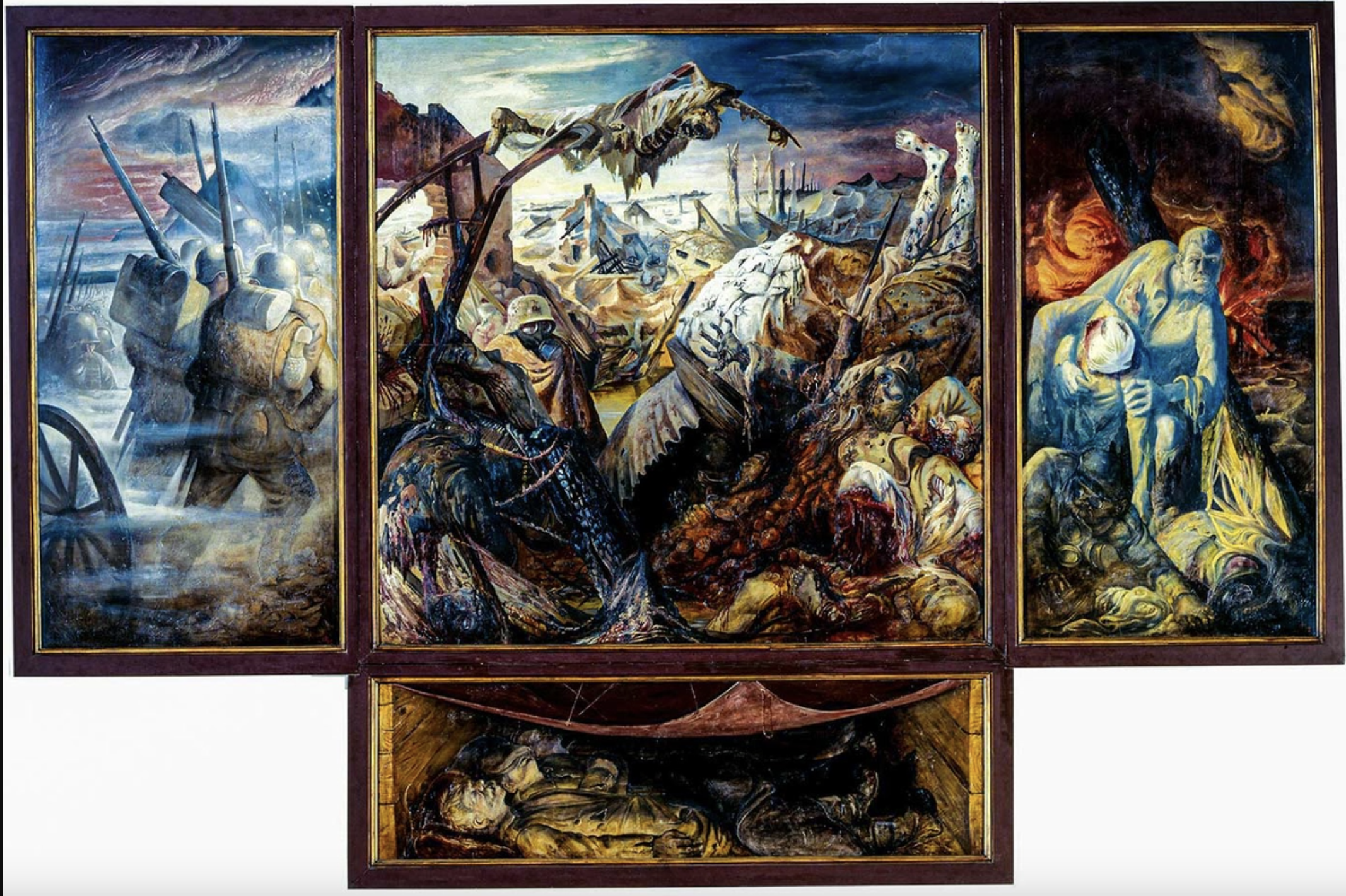
So long as you feel the pain,
Which I am spared,
Christ is unrecognised
As He works in the world.
For weak remains the Spirit
When it is only able to feel
The suffering of its own body.
– Rudolf Steiner
Rudolf Steiner offered this verse in his “Samaritans course” in 1914 for first aid practitioners in World War I. Elsewhere, he expressed a future that awaits us all in which we will each experience the suffering of everyone else. This will come not as something fully new, but rather as a revelation of what has always been. It will occur through a lifting of a veil of separation.
Suffering is, therefore, not a condition of disconnection, but something shared, something that belongs to all of us.
You may already know that “compassion” means “to suffer with.”
That someone else’s suffering is something that we have been forced to share is a far less difficult lesson that a lesson that accompanies it:
Our suffering is not our own. It does not belong to us.
In Bernard McLaverty’s short novel Cal, the eponymous main character is a young man who finds himself entangled with the Provisional IRA. While encountering the damage that violent borders can create, he considers the way his own pain relates to others.
“Once as a child he had an ear-ache — he had never felt pain like it before or since — and as he lay in bed with his throbbing head on a hot water bottle wrapped in a towel she had stroked his hair and said,
‘Just offer it up.’
It was her answer for everything, to turn pain and sorrow into a gift for God.
Cal was unsure of God but it came to him that the gift of suffering might work without Him. To offer it not up but for someone. ‘I suffer for you, you suffer for me.’ And that person might never know, that was the beauty of it.”
We view our suffering as personalized. We even want to talk about pain (and especially trauma) like it’s property, something that makes us us because we own it. And if my suffering is caused by others, and not shared with them, then I get to use it to forget about everyone else. It’s mine. This is helpful for a certain image of ourselves and others, for all sorts of reasons.
A few days later, I called my friend Doug and told him what happened, how I’d been thinking about how he was mugged in Brooklyn and then, almost immediately, I was assaulted on a street in Dublin.
“But I didn’t move because of the mugging,” he reminded me. “Don’t you remember? I moved because when I told the people in my neighborhood about it, they said I was lying to bring property values down so it would be easier for me to buy a place!”
Suffering isn’t supposed to divide us like that, or any other way for that matter.
There’s no lesson in this about what anyone should do in the face of immediate violence. Having experienced real abuse in my life, I don’t think people shouldn’t run or fight back or dis-identify with an abusive loved one. People should do what they need for refuge.
I’m only thinking now about what happens after that and what people think I was supposed to do.
I know I was supposed to hate the guy.
I know I was supposed to call the cops.
I know I was supposed to blame someone.
I know I was supposed to come up with a solution.
At the very least, I was supposed to kick the guy’s ass.
When I told the story of the assault more than one person said I should’ve hit him back.
I did find myself wishing I could have done something. But something for him.
I was nonreactive, that was good.
I’m not trying to paint myself as a hero, but I was happy to find that at some point in my life I’d moved beyond the threshold of chemical reaction. (I’ve seen evidence of this before in my life. I have what is referred to as the right “disaster personality.”)
So I didn’t escalate the situation, and it wasn’t because I was afraid or numb; I was calm.
On the other hand it still wasn’t enough. Taking a step past reactive fight or flight, and beyond freezing or rage, doesn’t tell us how to act.
But maybe in spite of the feeling, I wasn’t supposed to act.
I was instead, supposed to hold the punch for him.
I might feel differently if I were hospitalized of course. Or if he did try to fucking cut my fucking throat. But that’s not what happened, and exaggerating the violence to make the pain more singular and therefore express it as mine would conceal the event and what it offered, ultimately.
I was supposed to meet, with the side of my skull, what he was contending with.
Connect with him, literally.
That ear-flicking my friend mentioned is just an inversion of neighborliness, after all.
The shadow form of togetherness. A compromised solution: when you’re bored, restless, upset, afraid, unmet, unnoticed, you might flick someone’s ear, too. When the ear flicking doesn’t bring you back into a sense of connection, then what.
The world seems to be demanding connection through suffering, affirming Rudolf Steiner’s understanding of the future.
Isn’t this something you can sense happening now? Hasn’t globalized media and imported and funded conflicts brought then cries of everyone else closer?
So what happens when we open up to all the suffering but we didn’t teach ourselves how to open up to it? How will we treat each other then? Who will we need to attack to connect?
All that said, I have to confess:
I do notice some fear now, over a month later.
A residue or maybe a ghost.
I’ve been afraid to look at people’s faces
I love to look at what someone is going through; to admire how different everyone’s faces are; to smile at passing neighbors, especially in the mornings.
Even when I’m weak and I’m breaking
I stand weeping at the train station
‘Cause I can see your faces
Faces are so meaning-full. Now I find myself looking away, or not looking at all. Pretending someone is walking by isn’t there at all. I find it a little harder, even, to look into the eyes of my boyfriend, my family, my friends.
It’s something I’ll have to overcome.
And I will. It’ll take a little while, but I can feel what’s growing from it. Which is this: thinking that our suffering belongs to us is far less painful than understanding it belongs to everyone.
When we open up to it being shared, others share the burden with and for us, too.
And our work to calm it, to heal it, becomes work for everyone, not just for us.
What will we see in each other’s eyes, then?


Leave a Reply